- Home
- Logifleet Blog
- Lost equipment on construction sites: what is it actually costing you?
Lost equipment on construction sites: what is it actually costing you?
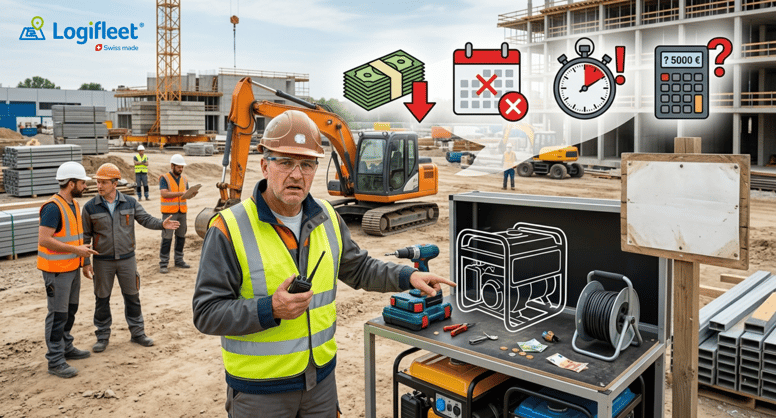
Every construction company has the same story.
A concrete mixer disappears between two sites.
A trailer sits idle at the depot for three weeks because nobody knew it was there.
A tool that "no one can find" gets rented again for CHF 800 per week.
These are not one-off accidents. They are the predictable, recurring result of managing equipment by memory, phone call, and paper list - and they happen every month, on every site, across every fleet that has no real-time visibility of its assets.
The uncomfortable question is not whether this is happening in your business. For the vast majority of Swiss construction companies managing more than a handful of assets, it is.
The real question is: what is it costing you, exactly - and are you measuring it?
The three hidden cost categories of untracked equipment
Lost and untracked equipment generates costs that never appear as a single line on any invoice. They are distributed across the P&L in ways that make them easy to miss individually but significant in aggregate. Most construction companies, when they first look carefully, find that these costs fall into three distinct buckets:
- Duplicate rentals - renting equipment you already own because you cannot locate it quickly enough. A generator rented for a week at CHF 400 while the company's own unit sits on a site forty minutes away is not exceptional; for many SMEs, it is a monthly occurrence.
- Administrative overhead - the hours spent by depot managers, site supervisors, and office staff on manual inventory checks, phone-around calls to locate assets, and re-entering data from paper logs. This time is invisible on the payroll but very real in its opportunity cost.
- Worker downtime - time lost when a crew arrives on site and the equipment they need is not there, or when a machine breaks down and no one can quickly identify where the replacement is located. At CHF 60-80 per worker-hour in construction, even two hours of idle time per week per site adds up fast.
None of these appear as "equipment tracking costs" on your monthly statements. They are absorbed into payroll, rental, and general operational lines - which is precisely why most companies significantly underestimate them until they measure them properly.
CHF 114,000 per year: one company's real number
Liebhauser & Deleze SA is a construction company based in Sion, canton Valais. Like most Swiss construction SMEs, they were managing their machines, vehicles, and tools with spreadsheets and informal handovers. The depot manager knew roughly where the major assets were. The problem - as it is for almost every company in this situation - was the word "roughly."
When they implemented Logifleet's mixed fleet tracking platform across their vehicles, heavy machines, and tools, they did something most companies have never done: they started measuring what had previously been invisible. The results, calculated across a full year of operation, were substantial.
CHF 114,000 saved per year 120 hours of admin time recovered 60 hours of depot manager time recovered 45 hours of worker time recovered
"No more wasted time and no more unnecessary costs."
- Julien Deleze, Director, Liebhauser & Deleze SA, Sion (VS)
The CHF 114,000 figure breaks down across the three cost categories described above. Rentals that were being placed because assets were not findable were eliminated once the depot manager could see every machine's location in real time. Administrative hours dropped sharply because inventory became automatic - no more phone rounds, no more manual counts. And worker downtime decreased because the right equipment reached the right site at the right time, reliably.
How construction fleet tracking works in practice
Logifleet installs compact tracking units on vehicles, heavy machines, containers, trailers, and smaller tools. No infrastructure investment is required - units are added directly to existing assets, and the platform is operational within days. Once installed, every asset reports its position continuously. The depot manager or fleet manager opens a single web-based dashboard and sees - in real time - where every piece of equipment across every site actually is.
The practical effect on daily operations is immediate.
When a site supervisor needs a compressor, the question is no longer "should we rent one?" It becomes "where is ours and when can it get here?" That shift, applied consistently across a fleet of 20 or more assets, eliminates duplicate rentals within the first weeks of use.
For depot managers, the change is equally significant. Manual inventory - the time-consuming, error-prone process of physically counting and cross-referencing assets - becomes redundant. The platform records every movement automatically. Inventory is always current. The depot manager's time is available for operational work rather than asset archaeology.
For companies with ERP systems - SAP, Abacus, Messerli, Sorba, and 14 others - Logifleet integrates directly, so asset usage data flows into cost allocation and billing workflows without manual re-entry.
For Cellere Bau AG, a central Swiss construction company with 455 machines, this integration with SAP eliminated the reconciliation step entirely and produced cost allocation data accurate enough to be formally validated by the finance team.
The calculation every construction manager should do once
You do not need an external audit to get a meaningful estimate of what untracked assets are currently costing you. The data is already in your monthly accounts - it just needs to be isolated and labelled correctly.
- List every rental placed in the last three months for equipment categories you own. Estimate what percentage of those rentals might have been avoided if you had real-time visibility of your own fleet.
- Ask your depot manager to estimate their weekly hours on inventory-related calls and checks. Multiply by their hourly cost and by 52 weeks.
- Estimate the average number of hours per week that workers on your sites wait for equipment that is delayed or misallocated. Multiply by headcount and hourly rate.
For a construction SME with 20 to 60 assets across three or four active sites, this calculation typically produces a monthly figure between CHF 3,000 and CHF 12,000. Against that number, Logifleet's per-asset monthly pricing - which scales with fleet size - is almost always a straightforward decision. Most clients recover full implementation costs within their first quarter of use.
Where to start
The first step does not require a full fleet audit or a technical evaluation. Logifleet offers a no-obligation operational review for Swiss construction companies - a structured conversation about your current asset mix, your key pain points, and a preliminary estimate of recoverable spend. Most companies find that the review alone changes how they think about their equipment costs, whether or not they proceed with implementation.
The question, in the end, is a simple one: if CHF 114,000 per year is what one construction SME in Valais recovered by making its assets visible - what is the equivalent number for your fleet?
Request a free fleet review.

En Budron H9
CH-1052 Le Mont s / Lausanne
T +41 21 651 06 51
Merkurstrasse 25
CH-8400 Winterthur
T +41 71 277 52 47
