
2026. 25 minutes.
2027. 20 minutes.
2028. 15 minutes.
These are the thresholds that define how much of a painting crew’s daily travel time is unpaid under the new GAV 2026–2029 for the Swiss painting and plastering trade. Every year, the number gets smaller. Every year, more of the same journey becomes paid working time.
For painting companies whose employees drive from the workshop to customer sites every day, that progression is not abstract. It changes payroll calculations, working-time records, and the administrative processes that sit behind both.
It’s 6:15 a.m. A painting crew arrives at the workshop, loads paint, ladders and equipment into the company van, and leaves for the first customer site. The drive takes 22 minutes.
At the end of the day, the journey back takes another 24 minutes.
That is 46 minutes of daily travel time.
Until now, many painting companies may have handled journeys like this with handwritten timesheets, approximate travel times, or a standard internal rule. From 1 April 2026, the new GAV 2026–2029 for the Maler- und Gipsergewerbe introduces a clearly defined, legally enforceable system for determining which part of that daily travel is unpaid and which part must count as paid working time.
And the threshold gets progressively lower every year.
The topic in short: what changes for painting companies?
Under Article 8.8 of the GAV 2026–2029, the daily round-trip travel time between the workshop and a work site is split into two parts: an unpaid threshold and compensable travel time above it.
Key changes include:
- a progressive travel-time threshold that decreases from 25 minutes in 2026 to 20 minutes in 2027 and 15 minutes in 2028,
- a clear obligation to document working hours and travel time under Article 8.9, using the ZPBK working-time control or an equivalent system,
- a separate treatment for travel between two customer sites, which counts as productive working time under Article 8.2,
- and meaningful sanctions for companies that fail to maintain the required records.
For painting businesses managing mobile teams across changing customer sites every day, this is not simply an HR topic. It directly affects payroll, working-time records, and what happens when the ZPBK comes to inspect.
Who Is Covered, and Since When?
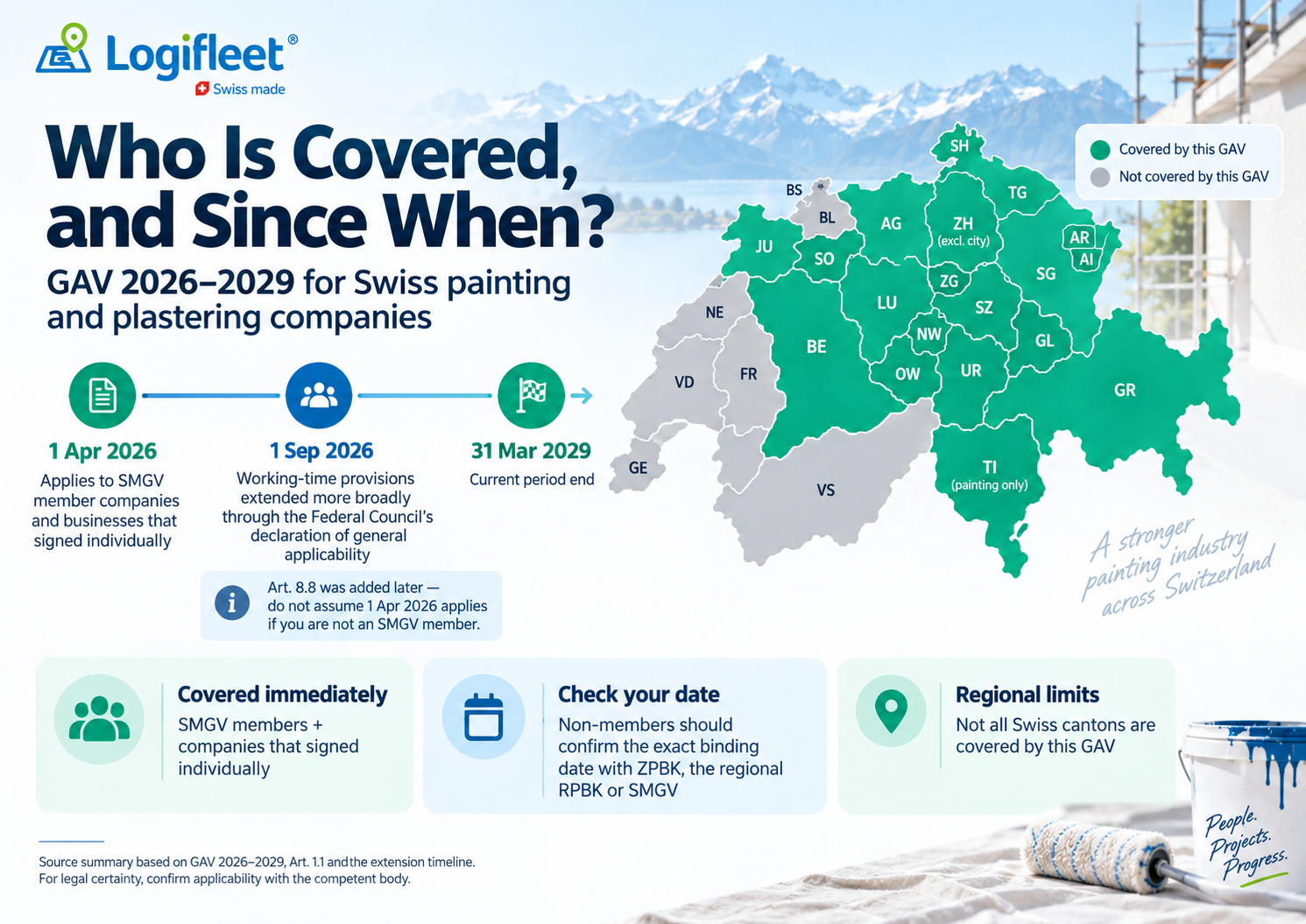
The GAV 2026–2029 was signed by SMGV, Unia and Syna and took effect on 1 April 2026 for SMGV member companies and businesses that signed the agreement individually. The Federal Council then extended the GAV to the whole trade through an Allgemeinverbindlicherklärung (declaration of general applicability); the latest amendment, covering the GAV's working-time provisions, took effect 1 September 2026 and runs through 31 March 2029. Official GAV records show Article 8.8 specifically was excluded from an earlier stage of that extension and added later. Do not assume 1 April 2026 applies to your business if you are not an SMGV member – confirm the exact binding date with the ZPBK, your regional RPBK, or the SMGV.
The agreement's scope is also geographically limited. Per Article 1.1, it covers the painting and plastering trade in the cantons of Zurich (excluding plastering work in Zurich city), Bern, Lucerne, Uri, Schwyz, Obwalden, Nidwalden, Glarus, Zug, Solothurn, Schaffhausen, Appenzell Ausserrhoden, Appenzell Innerrhoden, St. Gallen, Graubünden, Aargau, Thurgau and Jura, plus painting work only in Ticino. Geneva, Vaud, Valais, Neuchâtel, Fribourg and both Basel cantons are not covered by this GAV – painting and plastering businesses there should check whether a separate cantonal agreement applies to them.
What Article 8.8 Actually Says
The rule is straightforward. Each year, a fixed amount of daily round-trip travel time between the workshop and the work site is not considered paid working time. Any travel above that threshold must be compensated.
|
Year |
Unpaid threshold |
If daily travel = 45 min |
Paid travel time |
Art. |
|
2026 |
25 min |
45 min |
20 min |
8.8 |
|
2027 |
20 min |
45 min |
25 min |
8.8 |
|
2028 |
15 min |
45 min |
30 min |
8.8 |
The same physical journey generates more paid working time every year. A crew travelling 45 minutes a day earns 20 minutes of compensable travel in 2026, 25 minutes in 2027, and 30 minutes in 2028 - without anything about their route or schedule changing.
For one employee, the annual difference may appear manageable. Across 20 employees travelling to different sites five days per week, it becomes a payroll and administrative process that must work correctly every single working day.
Two Different Rules: Workshop Travel vs. Site-to-Site Travel
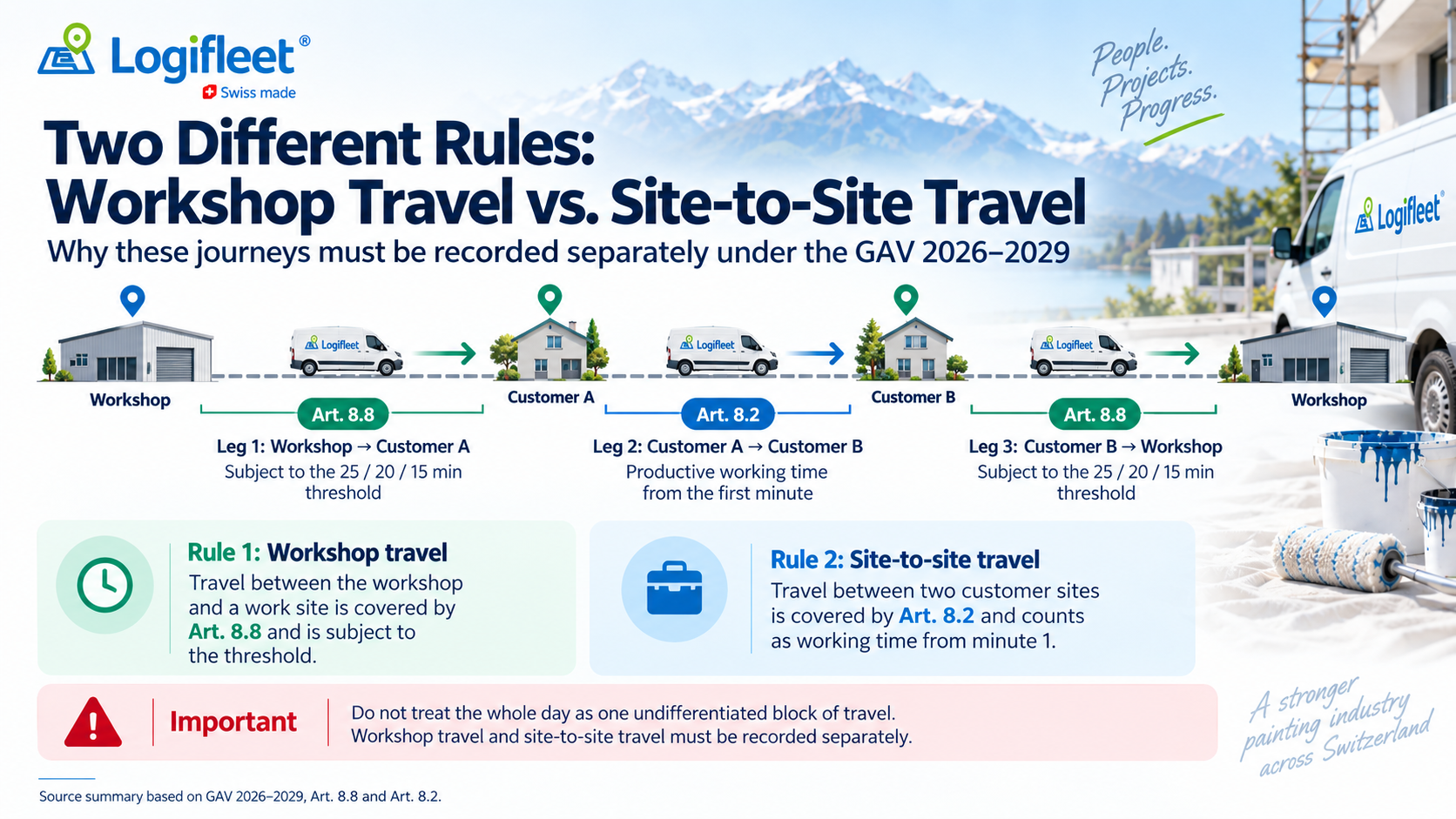
This distinction is important and often overlooked.
Article 8.8 governs travel between the workshop and the work site. That is the journey subject to the 25/20/15-minute threshold.
Article 8.2 takes a different approach to movement during the working day. It defines productive working time to include, explicitly, travel from one work site to another. A painter who drives from Customer A’s premises to Customer B’s premises mid-morning is not subject to the Article 8.8 threshold. That journey is productive working time from the first minute.
In practice, a typical painting day might involve both kinds of movement: workshop to the first site (subject to the threshold), a midday transfer to a second customer (productive working time under Art. 8.2), and the return to the workshop (also subject to the threshold).
Treating the entire day as one undifferentiated block of ‘travel’ is incorrect under the GAV. The two movements need to be recorded separately - and that requires knowing when and where the vehicle actually moved.
A Practical Example: The Same Day, Three Different Payroll Results
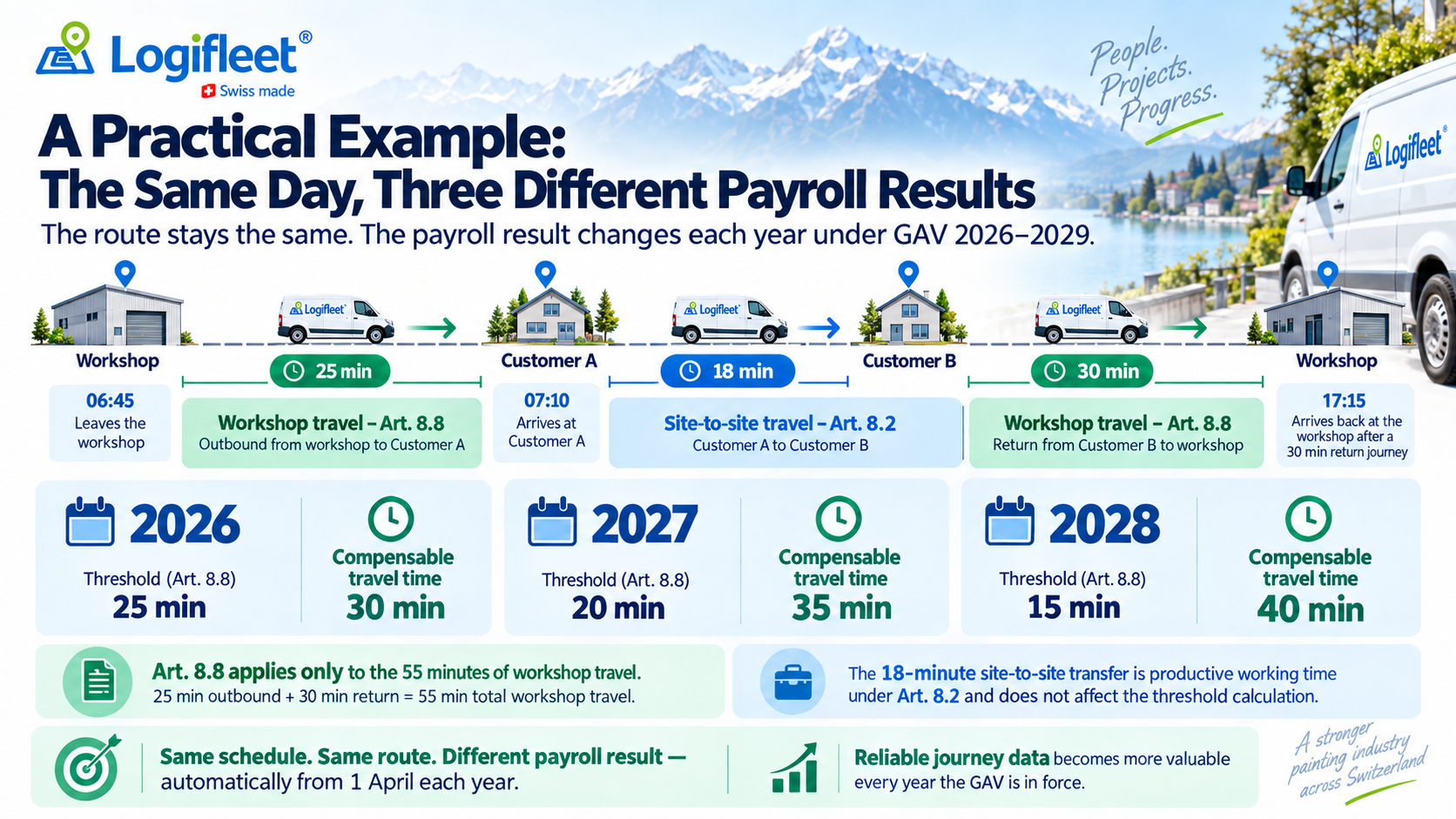
Imagine a crew that leaves the workshop at 06:45, arrives at the first customer at 07:10, transfers to a second customer at midday (18 minutes), and returns to the workshop, arriving at 17:15 after a 30-minute return journey.
Workshop-to-site and site-to-workshop travel totals 55 minutes (25 minutes outbound + 30 minutes return).
The 18-minute site-to-site transfer is productive working time under Article 8.2 from the first minute. It does not interact with the Article 8.8 threshold at all.
The Article 8.8 calculation applies only to the 55-minute workshop travel:
- In 2026, the 25-minute threshold leaves 30 minutes of compensable travel time.
- In 2027, the 20-minute threshold leaves 35 minutes of compensable travel time.
- In 2028, the 15-minute threshold leaves 40 minutes of compensable travel time.
The employee’s schedule has not changed. The customer sites have not moved. The van is driven the same route. What changes is the payroll result - automatically, on 1 April each year.
That is why reliable journey data becomes more valuable every year the GAV is in force, not less.
The Documentation Obligation: Article 8.9
Article 8.9 places a clear legal obligation on employers. Working hours and travel time must be recorded accurately and in full, based on operational working-hour reports. For this purpose, companies must use either the ZPBK’s working-time control system or a replacement system that is equivalent in every respect.
The documentation requirements are not optional. Three specific obligations follow from this:
- Employees must receive their working-time record at the end of the year or when their employment ends.
- Employees have the right to inspect their working-time records at any time.
- Records must be retained for at least five years, running from the end of the calendar year in which the last entries were made.
The GAV therefore moves the operational question beyond “approximately how long does it normally take to reach that site?” The relevant question becomes: can the company reliably document the travel time that formed the basis of its working-time calculation, for every employee, for every working day?
What Happens When Records Are Missing
The Zentrale Paritätische Berufskommission (ZPBK) and its regional commissions have significant enforcement powers. The penalties for documentation failures are scaled by company size for working-time record violations, and are fixed at high amounts for retention and inspection failures.
|
Company size |
Max. penalty |
Violation |
|
1–2 employees |
CHF 3,000 |
No working-time records (Art. 8.9) |
|
3–6 employees |
CHF 6,000 |
No working-time records (Art. 8.9) |
|
7–10 employees |
CHF 12,000 |
No working-time records (Art. 8.9) |
|
11–15 employees |
CHF 20,000 |
No working-time records (Art. 8.9) |
|
16–20 employees |
CHF 35,000 |
No working-time records (Art. 8.9) |
|
> 20 employees |
CHF 50,000 |
No working-time records (Art. 8.9) |
|
Any size |
CHF 50,000 |
Records not retained 5 years (Art. 6.4) |
|
Any size |
CHF 100,000 |
Records withheld during inspection (Art. 6.4) |
A company that has maintained some form of working-time control - even if it does not meet every GAV requirement - may receive a reduced penalty at the commission’s discretion. A company with no records at all has no such recourse.
These are not theoretical risks. The ZPBK commissions conduct active inspections across the painting and plastering trade. Working-time documentation is consistently among the areas they examine.
Why Manual Recording Becomes Difficult at Scale
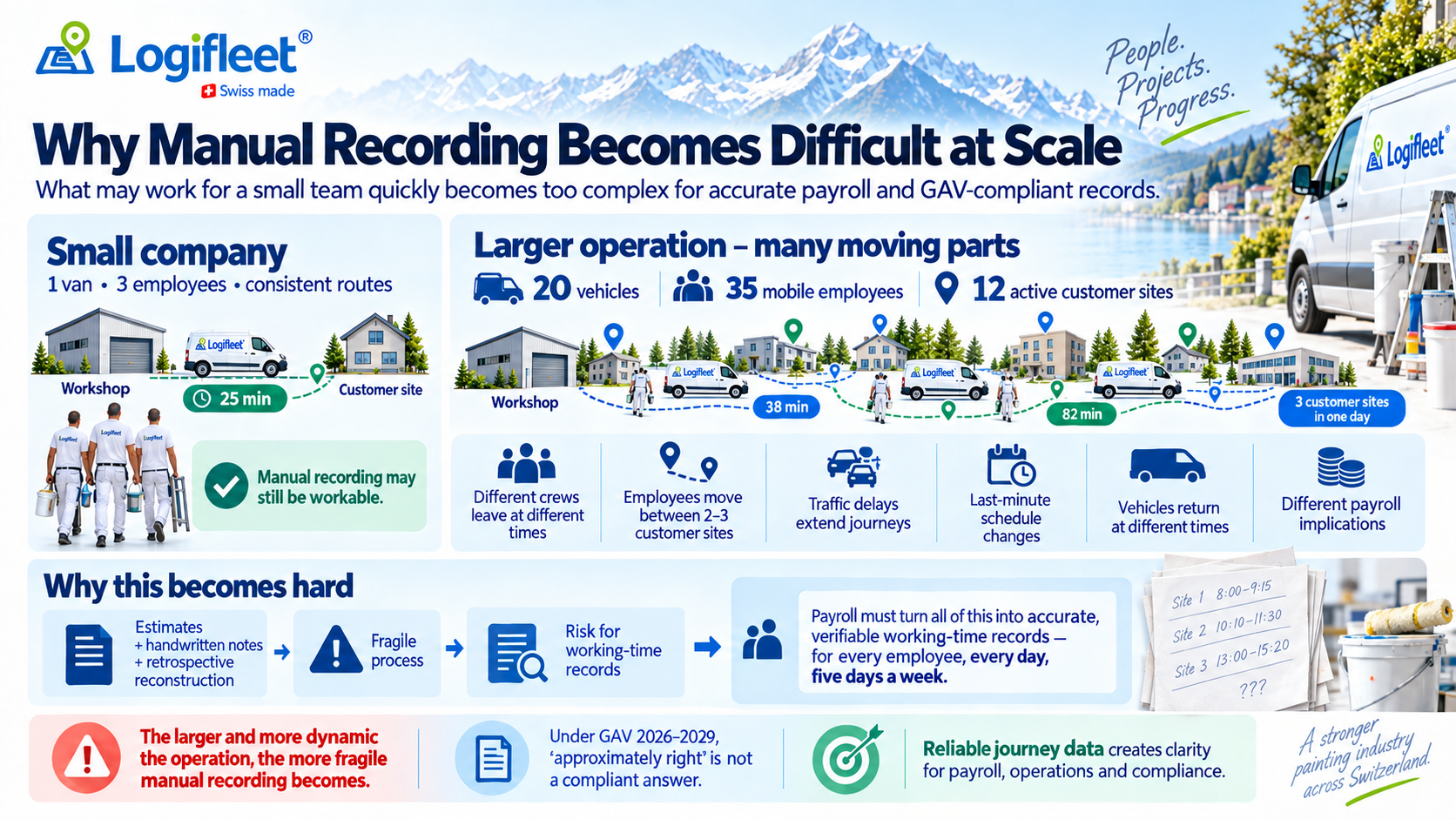
For a small painting company with one van and three employees working consistent routes, recording travel manually may remain workable. The complexity increases quickly.
Consider a business with 20 vehicles, 35 mobile employees, and 12 active customer sites. On any given day:
- different crews leave for different sites at different times,
- some employees transfer between two or three customer locations mid-day,
- traffic delays extend some journeys unpredictably,
- last-minute schedule changes redirect crews after departure,
- and vehicles return at different times with different payroll implications.
One employee may travel 38 minutes. Another, assigned to a more distant project, may travel 82 minutes. A third starts at one site and moves between three customer locations. Payroll eventually has to transform all of this into accurate, verifiable working-time records - for every employee, every day, five days a week.
The larger and more dynamic the operation, the more fragile a process based on estimates, handwritten reports, and retrospective reconstruction becomes. And under the GAV 2026–2029, ‘approximately right’ is not a compliant answer.
How Logifleet Supports GAV Compliance for Painting Companies
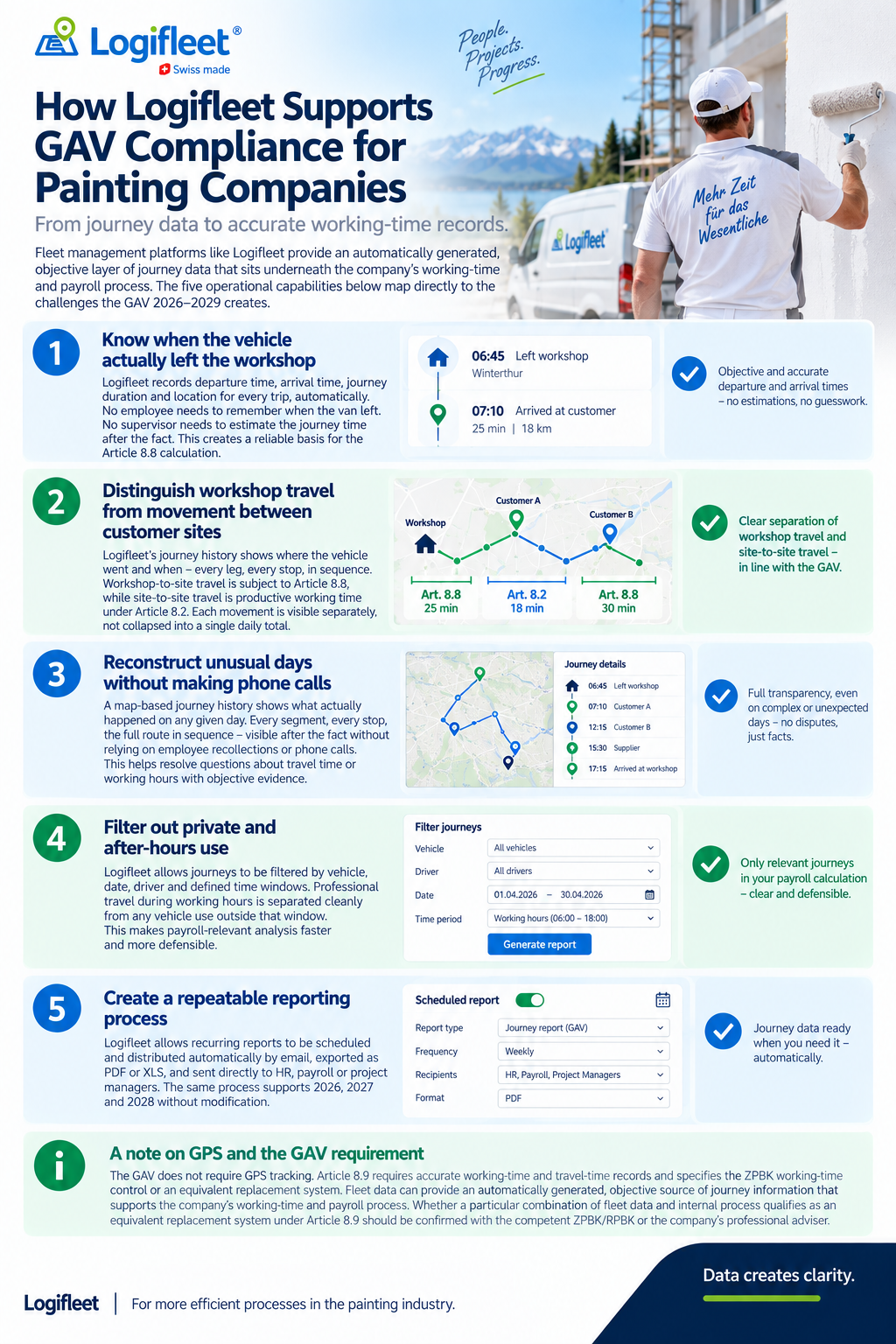
Fleet management platforms like Logifleet provide an automatically generated, objective layer of journey data that sits underneath the company’s working-time and payroll process. The five operational capabilities below map directly to the challenges the GAV creates.
1. Know when the vehicle actually left the workshop
Logifleet records departure time, arrival time, journey duration, and location for every trip, automatically. No employee needs to remember when the van left. No supervisor needs to estimate the journey time after the fact.
For the Article 8.8 calculation, this creates a reliable operational basis: the actual departure time from the workshop and the actual arrival time at the customer site, available for review without relying on anyone’s recollection. In the 06:45 example above, the 25-minute outbound journey is documented without manual input.
2. Distinguish workshop travel from movement between customer sites
This is where the two-rule structure of the GAV becomes operationally significant.
Logifleet’s journey history shows where the vehicle went and when - every leg, every stop, in sequence. Operations and payroll teams can reconstruct a full working day: the workshop-to-site leg subject to Article 8.8, the mid-day site-to-site transfer treated as productive working time under Article 8.2, and the return journey. Each movement is visible separately, not collapsed into a single daily total.
In the example above, the 18-minute transfer between Customer A and Customer B appears as a distinct journey segment - clearly separate from the workshop legs, clearly treated differently for payroll purposes.
3. Reconstruct unusual days without making phone calls
Painting operations rarely go exactly to plan. A customer postpones access. Materials need to be collected from a supplier. A crew is redirected to another project mid-route. Traffic extends the return journey by 25 minutes.
With a map-based journey history, a supervisor can see what actually happened on any given day. Every segment, every stop, the full route in sequence - visible after the fact without relying on employee recollections or phone calls to reconstruct the timeline.
This matters particularly when an employee questions their recorded travel time or working hours. The journey data either confirms the record or identifies where the discrepancy arose. Either outcome is better than a dispute that cannot be resolved with any objective evidence.
4. Filter out private and after-hours use
Not every kilometre driven in a company vehicle belongs in the GAV working-time calculation. Logifleet allows journeys to be filtered by vehicle, date, driver, and defined time windows. Professional travel during working hours is separated cleanly from any vehicle use outside that window.
This makes payroll-relevant analysis faster and more defensible - particularly when preparing documentation for an inspection or responding to a working-time query from an employee.
5. Create a repeatable reporting process instead of monthly reconstruction
The real operational advantage is not simply knowing where vehicles went. It is creating a process that runs the same way every week, without requiring someone to manually assemble a travel history at the end of each month.
Logifleet allows recurring reports to be scheduled and distributed automatically by email, exported as PDF or XLS, and sent directly to HR, payroll, or project managers. The underlying journey information is already available when payroll needs it - not something that needs to be reconstructed from memory and fragmented notes.
As the Article 8.8 threshold decreases each year, the financial relevance of accurate journey data increases. The same process that supports 2026 payroll calculations supports 2027 and 2028 without modification.
A note on GPS and the GAV requirement
The GAV does not require GPS tracking. Article 8.9 requires accurate working-time and travel-time records and specifies the ZPBK working-time control or an equivalent replacement system.
Fleet data can provide an automatically generated, objective source of journey information that supports the company’s working-time and payroll process. Whether a particular combination of fleet data and internal process qualifies as an equivalent replacement system under Article 8.9 should be confirmed with the competent ZPBK/RPBK or the company’s professional adviser.
Conclusion
Back to the 6:15 a.m. departure. The crew drives 22 minutes to the first customer site, transfers to a second location mid-morning, and returns 30 minutes to the workshop at the end of the day.
Under the GAV 2026–2029, those three movements are treated differently, calculated differently, and documented separately. The 25-minute outbound threshold applies in 2026. In 2027 it will be 20 minutes. In 2028, 15.
The challenge is less about understanding one threshold. It is about applying the correct threshold to every employee, every vehicle, and every working day - consistently, traceably, and in a form that satisfies the documentation requirements of Article 8.9.
Fleet data does not replace the GAV or the company’s working-time system. It does something more practical: it provides reliable evidence of how the working day actually unfolded. And for painting companies managing mobile teams across changing customer sites, that makes the difference between having the information when payroll needs it and reconstructing it from memory.
Frequently Asked Questions
How much travel time is unpaid for painters under the GAV 2026–2029?
From 1 April 2026, up to 25 minutes of daily round-trip travel time between the workshop and the work site is unpaid. The threshold decreases to 20 minutes from 1 April 2027 and 15 minutes from 1 April 2028. Travel above the applicable threshold counts as compensable working time under Article 8.8.
Does the GAV apply to my business if I'm not an SMGV member?
It depends on the provision and the date. SMGV members and businesses that signed the GAV individually have been bound since 1 April 2026. The rest of the trade becomes bound through the Federal Council's Allgemeinverbindlicherklärung, which was extended to cover working-time provisions, including Article 8.8, during 2026 – the latest amendment took effect 1 September 2026. Because this extension was updated more than once, confirm the exact binding date for your business with the ZPBK, your regional RPBK, or the SMGV rather than assuming 1 April 2026 applies. The agreement also does not cover Geneva, Vaud, Valais, Neuchâtel, Fribourg or Basel – check your cantonal agreement if you operate there.
Does travel between two customer sites count as working time?
Yes. Article 8.2 of the GAV explicitly lists moving from one work site to another as productive working time. This travel is compensable from the first minute and is not subject to the Article 8.8 threshold.
Do painting companies have to record travel time?
Yes. Article 8.9 requires companies to keep accurate records of working hours and travel time based on operational working-hour reports. The ZPBK working-time control or an equivalent system must be used. Employees are entitled to receive their records annually and to inspect them at any time.
How long must records be retained?
Records relating to wage-relevant GAV provisions must be retained for at least five years under Article 6.4. The retention period begins at the end of the calendar year in which the last entries were made.
What are the penalties for missing records?
Penalties for failing to maintain working-time records are scaled by company size under Article 6.5, reaching up to CHF 50,000 for companies with more than 20 employees. Failure to retain records for the required five years can result in a penalty of up to CHF 50,000. Withholding records during an inspection can result in a penalty of up to CHF 100,000.
Does the GAV require GPS tracking?
No. GPS is not explicitly required. Article 8.9 requires the ZPBK working-time control or a replacement system equivalent in every respect. Fleet data can support that process by providing automatically recorded journey information, but whether a specific system qualifies as an equivalent replacement should be confirmed with the competent ZPBK/RPBK or a professional adviser.
Does the threshold change automatically each year?
Yes. The threshold decreases on fixed dates: 25 minutes until 31 March 2027, 20 minutes from 1 April 2027 until 31 March 2028, and 15 minutes from 1 April 2028 for the remainder of the GAV period. No action is required from the employer for the change to take effect - it applies automatically.

En Budron H9
CH-1052 Le Mont s / Lausanne
T +41 21 651 06 51
Merkurstrasse 25
CH-8400 Winterthur
T +41 71 277 52 47
